Review of 'Tolstoy'
Tolstoy by Henri Troyat
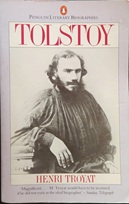 When you say the word “Tolstoy” most people's thoughts will immediately turn to his most famous work “War and Peace”. Likely they will know of it for one thing: It is very long. This is certainly true (see my review here) but so to is this biography by Henri Troyat.
Tolstoy was born into the life of the Russian Aristocracy in 1828 and lived the life of a wealthy bachelor for many years complete with gambling problem and an inability to make any decisions about his life. Or, rather, he made lots of these but he would then turn an about face a day or so later, never satisfied. One thing he always felt was discomfort at being the lord of his family home Yasnaya Polyana and the serfs that lived on the estate working to free them well ahead of the official Emancipation of 1861, causing many estate owners in the area a lot of grief. This would eventually appear in his later critiques of wealth, power and inequality that would culminate on his turning his back on the religious order, shunning as much of his worldly wealth as he was allowed, and becoming a dangerous figure for the establishment.
Despite his frequent sexual liasons he married fairly late to a young woman, Sophia Tolstaya, who had no experience with men, in particular dominating men such as Tolstoy. As Tolstoy began writing she would become his secretary, copying his scribblings into something suitable for submission for publication and she would also give birth to his 14 children.
Even though he was a radical social activist at the time, Tolstoy is remembered more for his writing which was passionate and extremely popular from the very beginning. Initially he started writing autobiographical stories but quickly moved onto fiction with thinly vailed references to his own experiences which were many. He served somewhat unsuccessfully in the military, not satisfied at being given a higher rank, not combative role. He spent many years travelling as well so had a good understanding of various cultures and people of the time. At one point he established a school on his property that encouraged children to find their own way rather than follow set curriculum which was quickly denounced by the education community but proved very popular. In both of these he grew bored but he never bored of writing. Indeed, he regularly added his deeply personal thoughts to his personal diary that he encouraged his wife to read in the interest of full disclosure, leading to quite a lot of tension. Both his and his wife's diaries would eventually be published, serving as an important source of the material in this book which often quotes from them.
Despite his shunning of wealth and fame, Tolstoy gained them with his writing. It was tremendously popular both in Russia and abroad leading lead to great acclaim with people regularly making pilgrimages to his estate where they would be received and talked to. He also received a huge amount of correspondence which he would spend a good amount of his day reviewing and responding where he felt necessary.
In his final years his health started to fail him and his relationship with his wife deteriorated significantly, falling out over the ownership of his writing which he insisted should belong to the people while his wife insisted be with her so she could support herself and the family. Hostilities led to him fleeing his home and eventually dying beside a railway station in the middle of nowhere – oddly reminiscent of some “media circuses” of modern day – The world watching and holding it's breath as a popular figure struggles and breathes his last.
This biography covers Tolstoy's entire life, discussing the impact he had on the people of his time, ending in the bizarre scenes of his death. It is clear he was a troubled man never completely satisfied with anything - his life, his wife, his work, his country - Yet incredibly popular and well-loved. He was a man who wanted to do the right thing and in doing so upset many in the establishment, but he did it anyway. It often feels that he was being difficult almost for the sake of being difficult, wanting to be contrary rather than through any deep-held conviction though later in his life, through practice I suppose, this did turn into dogma. Interestingly, when Tolstoy's key works are published Troyat switches from biographer relating historic events to reviewer, analyzing and commenting on the details of the work, which is slightly jarring but interesting, particularly if you are familiar with the works being discussed. In my case, I have read only “War and Peace” which I found quite good though tricky to follow…particularly as I knew very little of the events being discussed nor was I overly familiar with Russian place names and people names. It does make me more interested to read some of his other books such as “Anna Karenina” along with his more biographical “Childhood”, “Boyhood” and “Youth”, written when he was younger. I am not so sure I am interested in his later books which focus more on social and religious topics.
An interesting book that throws a light onto one of the greatest authors of all time. A surprising glimpse into the man and the impact he had in his time. Yes, it is long, but it is quite easy to read and always interesting if often a bit tedious following the many twists and turns of Tolstoy's actions and thought.
This edition of the book was translated from the original French by Nancy Amphoux. It features a small selection of black and white photos as well as appendices with biographical notes, notes to the text, bibliography and index.
Rating: “Nearly perfect, but not quite”
Review Date: 2026-05-19
Genre: Autobiography
Publisher: Penguin
Publication Date: 1970
ISBN: 0140580239