Review of 'Dead Aid'
Dead Aid by Dambisa Moyo
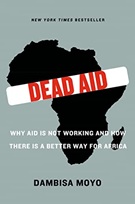 In “Dead Aid” (subtitled “Why aid is not working and how there is a better way for Africa”) Zambian economist Dambisa Moyo makes the argument that the long standing belief that aid would reduce poverty and increase growth has done exactly the opposite, resulting in increased poverty and declining growth with a conditioned dependence on the never-ending bucket of cash that keeps getting poured into the continent. Furthermore, this dependence has resulted in rampant institutional corruption causing inflation and much worse conditions for the people the aid was intended to help. Moyo tells the story of how this came about and the shifting focus of aid over the decades that has taken us to where we are today. The later sections of the book discuss how she feels true economic success can come to Africa by first stopping aid completely and introducing a free-market trade environment that rather than simply handing over money involves money exchanged for goods and services, specifically and at least initially, agricultural goods such as produce and meat which encourages trading nations to improve infrastructure so the goods can be effectively delivered. She points out that this is already being done successfully by China and other countries should follow suit with the ideological issues of their involvement here being less important the imperative of bringing countries out of poverty.
I have put off reading this book for a number of years as the subject hits quite home to me as I worked as a volunteer with VSO, a non-governmental organization (NGO), in The Gambia in the early 2000s. VSO, I felt, was different in that it talked more about sharing of skills rather than simply sending money, or providing manpower to build things - The emphasis was on “sustainability” leaving the country with your skills. I volunteered because I felt my experience and expertise in IT would help the country rather than, perhaps, building a school or donating a bunch of money. In this, I had always been sceptical of sending lots of money to Africa without really any accountability which I witnessed first hand in The Gambia. The vast amounts of money going into the country seemed to pay a bunch of NGO salaries and built the occasional building but generally things never really improved all that much in the three years I was there. It was an aid industry that seemed to accomplish little. I remember the big, fancy cars driven around the country by NGO hired drivers and the massive, modern compounds used by aid agencies, sealed off from the people they were meant to be helping. There was once a dinner for NGOs at the presidential palace where a close friend told me there were tables bending under the weight of the wonderful food they contained despite the country ranking 149th out of 161 countries in the UNDP's 2001 Human Development Index and poverty being at more than 50%. We had a conference to set the Department of Health budget being held in the opulent private resort owned by the president. On another occasion a “food donation” arriving in the country from a big international donor that consisted of copious quantities of “Kit Kat” which is of dubious quality nutritionally and ended up in the hands of a select few in the capital only (yes, I was given a pile). Obscene amounts of money have poured into the country but with little, if any, progress made towards economic independence.
I remember how patronizing I felt “Live Aid” and “Live 8” were - “Look at the poor starving Africans, let us give them some cash to make it all better” - A simplistic and generally destructive attitude towards poverty alleviation (don't get me started about the song “Do they know it's Christmas”…a patronizing and, frankly I feel, insulting portrayal of Africa…a modern day colonialism in the form of a pop song). Granted, the music was quite good…The “humanitarian” aspects, I feel, were not.
I am not sure I accomplished the lofty goals of VSO during my stay in The Gambia but since being there I have been told I made a difference in a few people's lives and for that I have to be satisfied. The longer term institutional structures such as budgets and, yes, aid mechanisms are unlikely to have lasted much beyond our stay there. I loved living in The Gambia and still feel I benefited personally from my stay more than the people of the country.
I agree with many of the conclusions made by Moyo in this book though the economics tools she discusses (such as government bonds and lending strategies), I have to admit, are somewhat over my head though she explains them in such a way that I think I know what she is getting at. In fact, one of the things she discusses “micro-finance” was the focus of one of my fellow volunteers when I was in The Gambia. I feel, however, that she missed an aspect of this which is how to build (or rebuild) the social structures that are largely missing though I am guessing she would argue this would come out of the economic development she mentions here. But, generally, it is horrible to hear of the scale of the issue and the scope of the damage it has caused and continues to cause throughout the continent.
After 50 years in The Gambia, VSO ceased operations there in 2015 citing strong legacy and confidence in local partners to continue poverty reduction efforts. In December 2016 presidential elections deposed long-time incumbent Yahya Jammeh (who led the military in taking over the country in a bloodless coup d'état in July 1994 and was accused of rampant corruption over the years of his leadership) and replaced him with Adama Barrow. Jammeh initially accepted the election results but contested them a few days later, deploying troops around the country to secure his power. Under increased international pressure from groups such as the United Nations eventually the Economic Community of West African States (ECOWAS) intervened militarily to force Jammeh to concede and leave the country after Barrow was sworn in as president in neighbouring Senegal. It is hoped that Barrow will not fall to corruption as his predecessor but without the change that Moyo discusses it could easily extend into more aid dependency and poverty for the people. Following the 2016 election UN agencies operating in the country increased from seven to fourteen. This does not seem like progress.
Understandably, “Dead Aid” is not an easy read but it is much needed, sobering look at the reality of aid that I feel most already know but chose to ignore…to Africa's huge and tragic cost.
Rating: “Nearly perfect, but not quite”
Review Date: 2026-03-08
Genre: Non-Fiction
Publisher: Douglas & McIntyre
Publication Date: 2009
ISBN: 9781553655428